
Does screen time affect speech development?

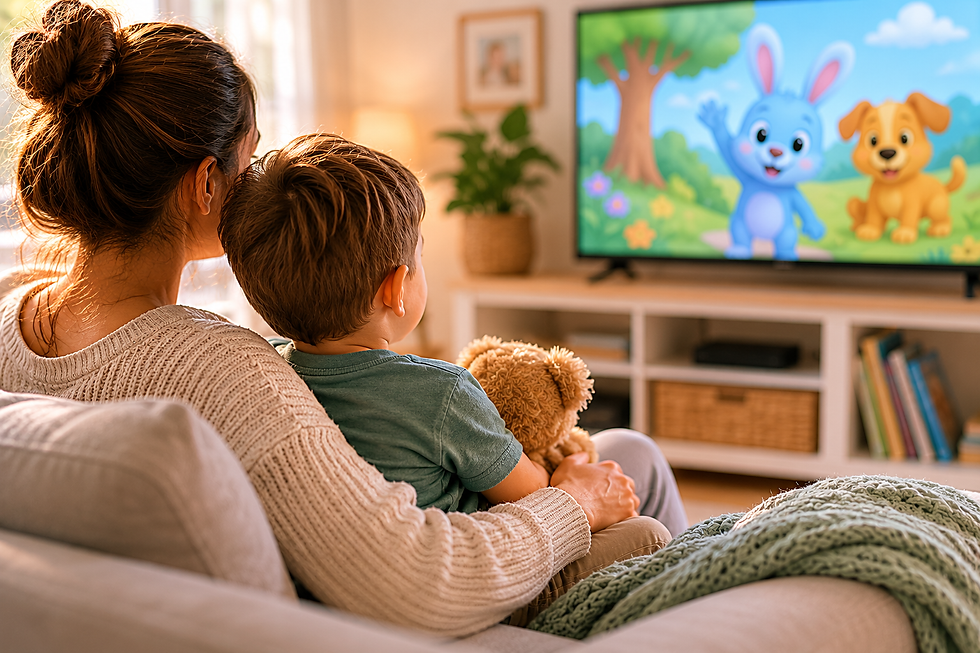
In today’s digital world, screens are everywhere; televisions, tablets, smartphones, laptops and even smart toys. Many parents wonder whether screen time can impact their child’s speech and language development. Research suggests that excessive or poorly managed screen time may impact speech and language development, particularly in young children. However, the relationship is more complex than simply “screens are bad”.
Why early interactions matter
Children learn language through real-life interactions. From birth, babies develop communication skills by:
Listening to voices
Watching facial expressions
Taking turns in “conversations”
Hearing words repeated in meaningful contexts
Playing and engaging with caregivers
Speech and language development relies heavily on responsive social interactions. Unlike face-to-face communication, screens can reduce opportunities for these back-and-forth exchanges.
Research suggests that high levels of screen exposure during the early years, particularly under 2 years of age, are associated with poorer vocabulary, language, attention and social communication outcomes.
What does the research say?
A growing body of research suggests that higher levels of screen time are associated with poorer language outcomes in young children.
A 2023 systematic review published in Brain Sciences found that prolonged screen exposure in early childhood was linked to difficulties with:
Vocabulary development
Language comprehension
Communication skills
Attention and social interaction
Another study conducted by Swider-Cios, Vermeij and Sitskoorn (2023) found that earlier introduction to screens, greater daily screen time and passive viewing (such as watching television without interaction) were associated with poorer language outcomes.
Furthermore, a 2024 Australian study published in JAMA Pediatrics highlighted that for every additional minute of screen exposure, toddlers heard fewer adult words, spoke fewer words themselves and participated in fewer conversations throughout the day.
Emerging research also suggests that content quality, caregiver involvement and what screen time replaces may be more important than screen time alone.
Is all screen time harmful?
Not necessarily.
Research suggests that the quality and context of screen use matter greatly. Educational, interactive and co-viewed content may be less harmful and, in some cases, beneficial compared to passive or unsupervised screen use. For example, the following screen time activities may support learning more effectively:
Watching educational programs together with a parent or caregiver
Talking about what is happening on screen
Singing songs or repeating words together
Using screens for short, purposeful activities
However, it is important to remember that screens should not replace play, social interaction, reading, outdoor experiences and conversations with caregivers. Real-world interactions play a critical role in supporting early language development.
Current screen time recommendations
Current recommendations from the World Health Organization (WHO), American Academy of Pediatrics (AAP) and Australian health guidelines suggest:
No sedentary screen time for children under 2 years (except video chatting)
No more than 1 hour per day for children aged 2–5 years, with less being better
Prioritising high-quality, interactive and co-viewed content
Practical tips for families
Here are some evidence-based ways families can support healthy communication development while managing screens:
Prioritise face-to-face interaction: Children learn language best through conversations, play and shared experiences
Limit passive screen time: Background television and passive viewing reduce opportunities for communication
Co-view when possible: Talk about what your child is watching and ask simple questions
Create screen-free routines: Try screen-free meals, playtime and bedtime routines
Encourage play and reading: Books, pretend play, singing and outdoor play all strongly support language growth
Model healthy screen habits: Children often copy adult behaviour around technology use
A balanced perspective
Technology itself is not inherently harmful. Screens can provide learning opportunities, entertainment and connection when used intentionally and in moderation. One of the primary concerns is when screen time replaces meaningful human interaction, which is a key foundation for speech and language development.
If you’re unsure about your child’s speech and language development or screen use habits, a speech pathology review can help provide clarity and practical next steps. Contact us at The Speech Spot for any further questions.


Comments